Property Management Guide 2026: Everything Owners Need to Know

Property management 2026 – what does that mean for you as an owner? Managing real estate is becoming increasingly complex, expectations are rising, and legal requirements are changing. Those who keep an overview can save a lot of money and avoid risks.
With this guide, you will gain clarity and confidence. You will learn how professional property management helps you avoid mistakes and secure the long-term value of your property.
We show you which tasks and obligations are coming your way, what costs to expect, and how to choose the right property management company. You will also get an overview of legal fundamentals and future trends.
Look forward to clear explanations, practical tips, and solid expertise for successfully managing your property.
What is property management? Definition and differentiation
A property management company is, for many owners, the backbone of real estate operations. It handles the professional organization, administration, and maintenance of residential or commercial properties. Classic property management takes care of all matters related to the property, ensures transparent processes, and helps secure its long-term value.
But what distinguishes the different forms of management? In everyday life, you encounter terms such as real estate management or WEG management. While real estate management covers all tasks related to buildings, land, and tenancy relationships, property management usually focuses on practical, operational activities. WEG management, by contrast, is specifically geared toward condominium owners’ associations (WEG) and deals exclusively with the common property.
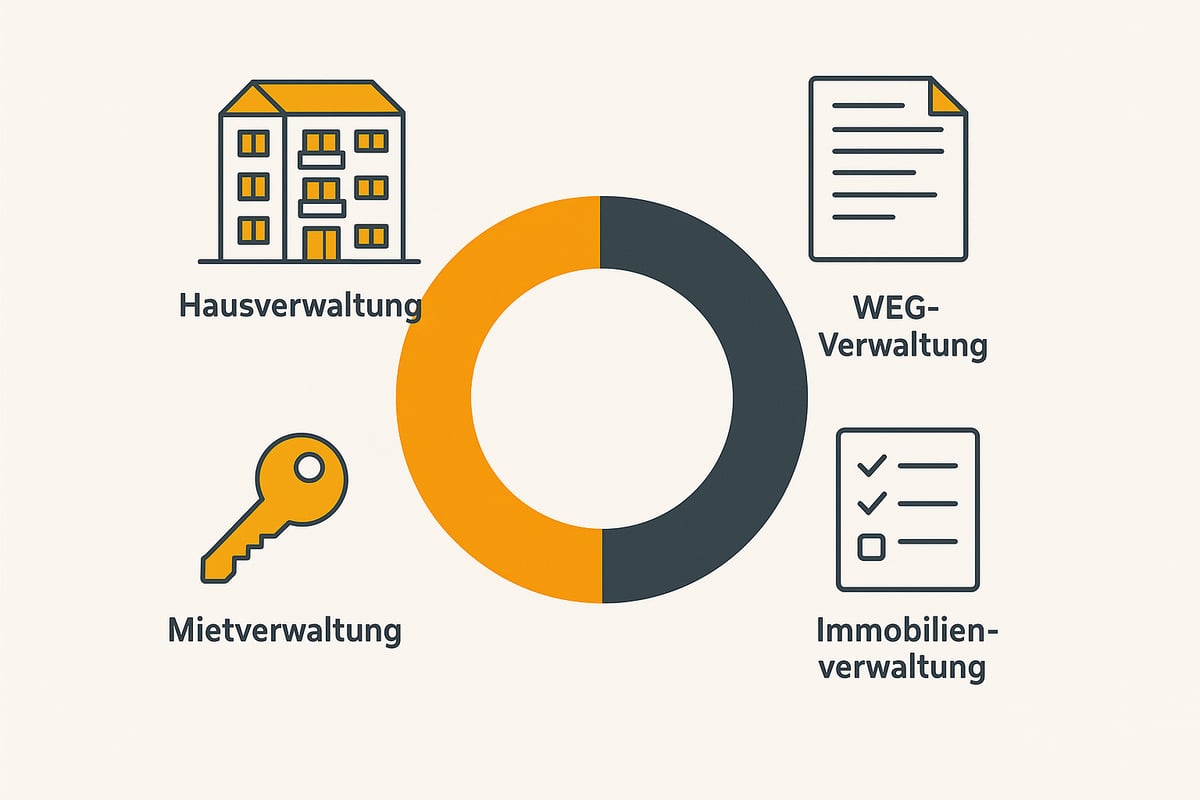
Differences between types of management
There are different forms. Rental management looks after rental properties, handles rent collection, and manages lease agreements. WEG management is about managing the common property in a condominium owners’ association. Separate property management complements both by looking after individual units on behalf of their respective owners.
A mixed management setup combines these models, for example in large residential complexes with mixed ownership and rental structures. In comparison, real estate management often also takes on strategic and technical tasks such as modernizations or major repairs.
Here’s a tabular overview:
|
Management type |
Focus |
Typical tasks |
|---|---|---|
|
Property management |
Operational management |
Accounting, maintenance |
|
WEG management |
Common property |
Meetings, resolutions |
|
Rental management |
Rental properties |
Tenant correspondence, collections |
|
Real estate management |
Holistic support |
Strategy, modernization |
Significance, practical examples, and legal foundations
In day-to-day operations, the manager ensures smooth processes: they organize repairs, communicate with tenants and owners, prepare statements, and ensure compliance with legal requirements.
The difference becomes clear especially in multi-unit buildings: while in a purely rental building the property management handles all tasks, in a condominium owners’ association the WEG management is responsible for the common property, while separate property managers look after the individual units.
Legally, this management is governed by the German Civil Code (BGB) and the German Condominium Act (WEG). The legal situation in 2026 brings additional requirements for transparency and documentation. According to VDIV, around 50 percent of all residential properties in Germany are professionally managed. You can find a more in-depth overview of tasks and selection criteria in the article Property management: Tasks, costs and selection.
Core tasks of property management
The core tasks of property management are crucial for preserving value and ensuring smooth use of a property. Compared to pure real estate management or WEG management, the manager handles the entire day-to-day business—from commercial control to technical support. Owners benefit when all tasks are carried out efficiently and transparently.

Commercial tasks
At the heart of property management are commercial activities such as collecting rents, preparing annual service charge statements, and maintaining complete bookkeeping. The management monitors incoming payments and reminds tenants in arrears. It ensures that all financial processes are documented and traceable.
Modern solutions such as accounting automation for property management make many processes easier today. Digital tools not only support payment management but also enable efficient handling of large volumes of data.
Typical tasks at a glance:
-
Rent collection and monitoring of rent payments
-
Preparation of service charge and operating cost statements
-
Bookkeeping and payment monitoring
-
Management of reserves and budget planning
Technical tasks
Property management organizes and controls all technical measures on the building. This includes regular maintenance to prevent damage and coordinating servicing of heating systems, elevators, or the roof. For modernizations or renovations, the manager handles planning, tendering, and supervision of construction work.
Selecting and managing external service providers such as cleaning companies or gardeners also falls into this area. Technical support is particularly important for maintaining the value of the property and ensuring living comfort.
Technical tasks include:
-
Regular property inspections and documentation of condition
-
Coordination of contractors and service providers
-
Planning and supervising maintenance measures
-
Implementation of modernization projects
Legal tasks and communication
Property management is responsible for contract management. It drafts and reviews rental agreements, enforces claims, and ensures that all legal requirements are met. Communication with owners and tenants is a central component, as transparency builds trust.
Owners’ meetings are organized, invitations sent, and resolutions documented. The management is the point of contact for all parties and mediates in conflicts.
Important legal tasks:
-
Conclusion and administration of rental agreements
-
Enforcement of house rules and claims
-
Compliance with legal deadlines and regulations
-
Organization of owners’ meetings
Annual statement and statistics
A central element of every property management is the preparation of the annual statement. All income and expenses are listed in detail and presented transparently for the owners. According to VDIV, an average management company oversees around 340 units—an indicator of the complexity and expertise required.
Special features for commercial properties and large residential complexes
For commercial properties or large residential complexes, the effort increases significantly. Property management must manage extensive contracts, monitor technical systems, and meet users’ individual requirements. Specialist knowledge and digital support are particularly important in such cases.
Costs and contract models in property management
The cost structure of management is a key decision criterion for owners. It consists of various components that can vary depending on the type of management and the property. In principle, a distinction is made between fixed amounts, percentage-based fees, and costs for additional services.
A look at WEG management shows that the average costs per housing unit were €22.23 per month in 2021 according to VDIV. For rental management, the fee is usually based on the base rent and is typically 5 to 6 percent. Separate property management is often cheaper but also offers a reduced scope of services.
The pricing of property management depends on several factors:
-
Location and size of the property
-
Condition and age of the building
-
Technical effort and number of units managed
-
Scope of desired additional services
The base fee usually includes standard commercial and organizational services, such as preparing the annual statement, bookkeeping, and communication with owners. Additional services such as organizing renovation measures, legal support, or digital services are often billed separately.
An example calculation for a typical unit in a WEG might look like this:
|
Management type |
Average costs per month |
Included services |
|---|---|---|
|
WEG management |
22,23 € |
Bookkeeping, statements, meetings |
|
Rental management |
5–6% of the base rent |
Rent collection, service charges, communication |
|
Separate property management |
10–15 € |
Management of individual units |
Not all management costs can be passed on to tenants. According to the Operating Costs Ordinance, management fees are not apportionable operating costs and must be borne by the owner. Transparency in contract design is therefore essential.
Digital solutions can support optimal cost control and efficient billing. Modern tools enable clear management of all financial flows and make planning easier. On the page Solutions for financial management in property management you will find practical approaches to optimizing cost management.
For contract models, pay attention to the precise definition of terms, notice periods, and scope of services. A carefully reviewed contract protects against unexpected additional costs and ensures clarity in the relationship between owner and management.

Selecting and commissioning a property management company
Choosing the right property management company is a crucial step for owners to secure the long-term value of the property. A professional manager not only ensures smooth processes but also protects against legal and financial risks. But what should you look for when hiring a property management company?

Important selection criteria
A good property management company is characterized by solid qualifications, many years of experience, and verifiable references. Recommended are managers with training as real estate management professionals as well as IHK certifications. Make sure the manager is a member of recognized professional associations and has relevant insurance such as business and professional liability (including financial loss).
Transparency in office organization, quick accessibility, and the use of modern digital tools are indispensable today. Digital solutions, such as those described under Digital workflows in property management, make communication and data management much easier.
Selection and commissioning process
The selection process for a property management company usually begins with a structured tender. Compare several offers and carefully check references. Request clear service descriptions and ask about experience with comparable properties.
After the preselection comes the personal meeting. Here you can clarify open questions and assess whether the property management company fits your requirements. Make sure the company makes its processes transparent and provides insights into its way of working.
In condominium owners’ associations (WEG), the decision is usually made at an owners’ meeting. The manager is elected by majority vote and the contract is signed jointly.
Contract signing and typical pitfalls
When signing the contract, you should pay attention to clear terms and realistic notice periods. Check which services are included in the base fee and what additional costs may arise. Typical contract terms are 2 to 5 years with automatic renewal unless notice is given.
Watch for transparent billing modalities and a comprehensible cost structure. A detailed contract protects both sides from misunderstandings. If in doubt, consult a specialist lawyer or an expert in property management.
Self-management vs. professional property management
Not every property needs to be managed by a professional manager. Smaller WEGs or owners’ associations with strong cohesion often opt for self-management. According to current statistics, about one in five residential complexes in Germany is self-managed.
Self-management offers advantages such as lower costs and more control, but requires time, expertise, and a willingness to take responsibility. For larger properties or more complex management tasks, the advantages of professional management usually prevail.
Checklist: How to find the right property management company
-
Check qualifications and certificates
-
Obtain references from other owners
-
Ask about membership in professional associations
-
Request proof of insurance
-
Review offer and contract for transparency
-
Test digital tools and accessibility
-
Have a personal conversation and trust your gut feeling
With this structured approach, you will find a property management company that fits your requirements and reliably looks after your property.
Legal foundations and current developments 2026
The foundation of every type of management is the German Civil Code (BGB) and the German Condominium Act (WEG). They govern the rights and duties of owners, tenants, and managers. The Operating Costs Ordinance defines which costs may be passed on to tenants. By 2026, various reforms have come into force that strengthen digitalization and transparency in property management. A central goal is to simplify processes and increase legal certainty for all parties involved.
Since the WEG reform, managers have been obliged to inform owners regularly and transparently. New requirements for documentation and data protection ensure that sensitive data is processed securely. Today, managers must offer digital communication channels and document decision-making processes in a traceable way. Owners have clearly defined participation rights, while managers have greater decision-making leeway for everyday measures, such as repairs or switching service providers. The limits of these powers are clearly defined by law to avoid conflicts of interest.
Digitalization is advancing rapidly. Many administrative processes now run via digital platforms, increasing efficiency and transparency. According to the VDIV Industry Barometer 2025, around 75 percent of companies use digital tools for property management. Digital solutions such as automated form processing make it easier to comply with new documentation requirements, as explained clearly at Process forms efficiently in digital form. For owners, this means more visibility, faster information, and greater day-to-day security.
Options for self-management for owners
Self-management is an attractive alternative to classic property management for many owners. In this case, the owners’ association or individual members take on the organizational and administrative tasks that an external manager would otherwise handle.
What are the prerequisites for self-management?
The prerequisite is that the owners agree and are willing to take responsibility. Legally, self-management is regulated by the German Condominium Act. Unlike with a traditional manager, there is no external service provider—the community organizes itself internally.
What are the advantages and risks?
The advantages are obvious:
-
Lower costs, as no management fees are incurred
-
Full control over decisions and processes
-
Direct communication within the community
But there are also risks:
-
High time commitment for organization and administration
-
Expertise in legal, technical, and commercial matters is necessary
-
Liability issues in the event of errors or omissions
Who is self-management suitable for?
Self-management is particularly suitable for:
-
Small WEGs with few units
-
Owners’ associations with strong cohesion
-
Owners who want to be actively involved
Practical example and support
A typical example: in a small residential complex with six units, the owners take turns performing management tasks. An external service provider is hired for the bookkeeping, and technical maintenance is discussed regularly together.
Many self-managers today use digital tools to simplify accounting and communication. External service providers can support special topics such as legal issues or billing.
How widespread is self-management?
According to current figures, the share of self-managed condominium owners’ associations in Germany is significantly lower than that of professionally managed properties. Nevertheless, this model is gaining in importance, especially for small units and committed owners.
You have now seen how diverse and complex property management can be in 2026—from legal requirements to digital trends. As an owner, you want to avoid mistakes and make your processes efficient and secure. This is exactly where a smart platform like filehub can offer real added value: you automate recurring tasks, keep documents and processes under control at all times, and stay on the safe side in terms of data protection. If you’re curious how simple digital property management can be today, just give filehub a try—try filehub.one for free now.


