Time Tracking – Efficient and Legally Compliant

Working time recording is mandatory for many companies in Germany. Are you prepared?
Efficient and legally compliant working time recording is not only a statutory requirement, but also a real advantage for employers and employees. Transparency, fairness and protection against fines are at the forefront.
In this guide, you’ll learn how to meet all requirements, choose the right system and ensure data protection. You can expect concrete practical tips, legal background and easy-to-implement solutions. That way you’re perfectly equipped..
Working time recording 2025: Legal innovations and obligations
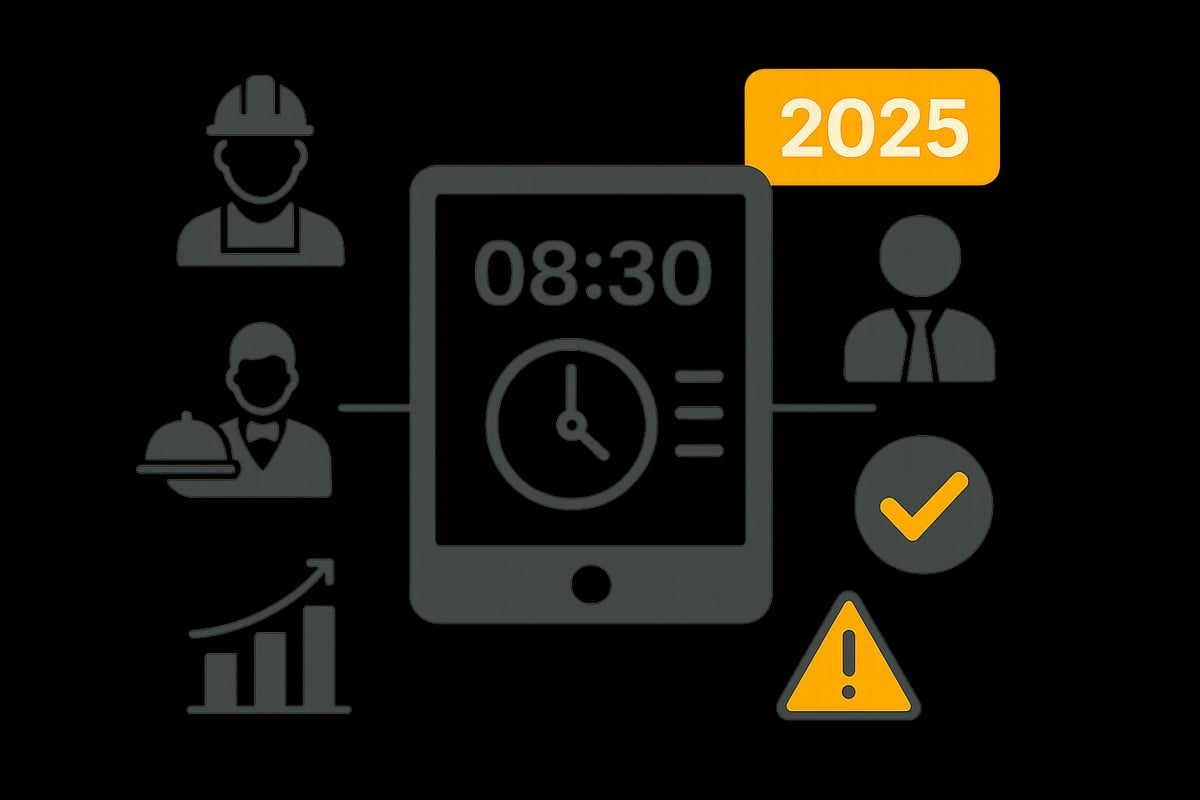
Working time recording is at a turning point in 2025. New legal requirements make systematic recording mandatory for all employers. Companies must now familiarize themselves with the details and react in good time to avoid fines and legal risks.
Current legal situation and ECJ ruling
The basis for working time recording is the Working Time Act as well as the landmark ECJ ruling from 2019. In 2022, the Federal Labour Court (BAG) confirmed that employers are obliged to record working hours systematically, completely and in a tamper-proof manner. This obligation applies to all companies without a transition period.
Electronic systems are recommended as the standard, as they make manipulation more difficult and simplify evaluations. According to current statistics, over 80 percent of companies must adapt their working time recording by 2025. Small and medium-sized enterprises in particular face challenges, as paper-based solutions have often been used up to now.
If you want to learn more about current employment law changes and the obligation to use electronic working time recording, the article Employment law changes 2025 provides a comprehensive overview.
Who must record working hours and exceptions
From 2025, working time recording is mandatory for all employees—regardless of working time model, part-time, mini-job or mobile work. Exceptions apply only to executive employees whose working hours are not controlled. There are also special regulations for certain sectors such as construction, hospitality or cleaning under the Act to Combat Undeclared Work.
Income thresholds and the exact job description serve as criteria for defining exceptions. One example: while a senior executive may be exempt from the obligation, regular employees must always document their hours. As a guide, the contribution assessment ceiling of the pension insurance applies.
Summary:
|
Group |
Obligation to record working time |
Exception possible |
|---|---|---|
|
Full-time/part-time |
Yes |
No |
|
Minijobbers |
Yes |
No |
|
Executive employees |
No |
Yes |
Consequences of non-compliance
Those who neglect the correct recording of working hours take significant risks. In the event of missing or incorrect records, fines can be imposed that amount to several thousand euros depending on the violation. The authorities carry out regular checks to ensure that legal requirements are being met.
Employers are also liable for incorrect payroll and wrongly documented overtime. This can lead to back payments, disputes with employees and even legal proceedings. Preventive measures, such as the early introduction of a tamper-proof system, save costs in the long term and protect against legal problems.
Models and systems of working time recording: Analog and digital solutions
Working time recording is a central topic for all companies in 2025. But which systems are suitable for different company sizes and requirements? From classic methods to modern, digital solutions, there are numerous options. Those who choose the right working time recording benefit from greater efficiency, transparency and legal certainty.
Classic methods: paper, timesheets, punch clock
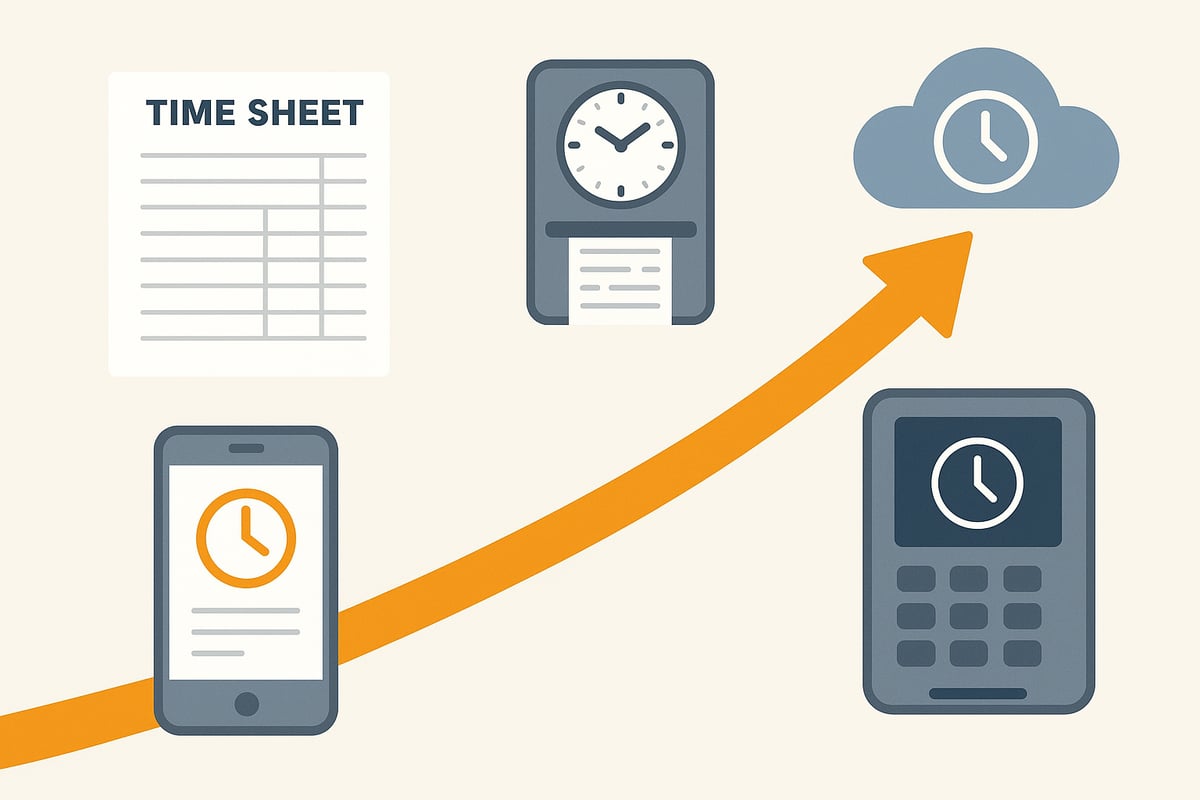
Many companies still rely on paper-based recording of working hours. This includes handwritten timesheets, classic punch clocks or simple written records. These methods are particularly used by small craft businesses or construction sites because they are quick and inexpensive to implement.
Advantages:
-
Low acquisition costs
-
Easy to use
-
No technical knowledge required
Disadvantages:
-
High error susceptibility
-
Risk of manipulation
-
Time-consuming evaluation
According to current surveys, over 30 percent of small businesses still rely on paper solutions for working time recording. However, as documentation requirements increase, these methods quickly reach their limits.
Digital systems: software, apps, terminals
Digital working time recording offers numerous advantages over analog systems. Companies use software solutions on the desktop, mobile apps for smartphones or special terminals with chip cards or fingerprints. These tools enable automatic, transparent and tamper-proof recording of working hours.
Typical digital solutions:
-
Cloud-based time recording software
-
Mobile apps for field staff and home office
-
Terminals with RFID or biometric identification
Advantages:
-
Automatic evaluation and reports
-
Direct integration with HR systems and payroll
-
Tamper protection and high transparency
More and more companies with 20+ employees are relying on digital working time recording. Modern systems can be flexibly adapted to different working models and save time in administration. You can find a comprehensive overview of digital solutions at Time recording solutions for HR.
Selection criteria and implementation
The choice of the right system for working time recording depends on several factors: company size, working time models, flexibility and costs play an important role. Involving the works council is often legally required when switching to digital systems.
Key selection criteria:
-
Scalability for growing teams
-
Ease of use for all employees
-
Legal compliance and data protection
-
Investment and operating costs
Transparent communication and training of employees promote acceptance of new systems. In medium-sized companies, investment in digital working time recording usually pays off quickly through efficiency gains and lower error risk. A clear migration plan and regular reviews ensure long-term success.
Industry-specific requirements and special regulations
Working time recording is not regulated in the same way in every industry. Depending on the field of activity and type of employment, special requirements and legal provisions apply. Companies should be aware of these differences to avoid fines and legal risks.

Industries with a special time recording obligation
In certain industries, working time recording is particularly strictly regulated. These include construction, hospitality, passenger transport, logistics, forestry, building cleaning, trade fair construction and the meat industry. The Act to Combat Undeclared Work and the Minimum Wage Act require seamless documentation of working hours here.
The records must be kept for at least two years. Especially for minijobbers, the law requires that the start, end and duration of daily working time be recorded precisely. Example: In a construction company, the foreman must keep and archive a timesheet for each person.
Current statistics show that over 60 percent of businesses in these sectors already use specialized recording systems. This reduces errors and makes inspections by authorities significantly easier.
Flexible working models and home office
Flexible working hours and home office present companies with new challenges in working time recording. Digital tools now enable location-independent and tamper-proof recording—whether in the office, on the road or at home.
Clear guidelines are needed to ensure that breaks, start and end of work, and overtime are correctly documented. Many companies rely on app-based systems that work reliably in remote teams as well. Digital process automation can help make working time recording efficient and legally compliant, as described in the article on digital process automation.
Transparency protects employees from overload and provides certainty in dealing with working hours. This minimizes sources of error and ensures that legal requirements are reliably met.
Minijobbers, part-time staff and special cases
Special documentation obligations apply to minijobbers and part-time staff. Here, daily working time recording is mandatory. Companies must keep accurate records and retain them for at least two years.
Practical example: A restaurant uses standardized templates for minijobbers to document working hours efficiently. There are differences compared to regular employees—such as the requirements for recording breaks or overtime.
According to current statistics, around 75 percent of minijobbers already use digital or standardized templates for working time recording. This simplifies evaluation and ensures greater legal certainty in HR administration.
Data protection and legal certainty in working time recording
The protection of personal data plays a central role in recording working hours. According to the GDPR, working time data is considered particularly sensitive and must be handled with the utmost care. Employers are obliged to make the recording, storage and processing of this data transparent and purpose-specific. The Working Time Act also requires separate processing of working time data and performance monitoring to prevent misuse.
Only authorized persons may access the data. Companies must also ensure that data is not stored longer than necessary and is used exclusively for the purpose of working time recording. Data protection violations can result in significant fines, which is why compliance with legal requirements is a top priority. Those who want to delve deeper into the requirements can find detailed information under Data protection for working time data.
Technical and organizational measures
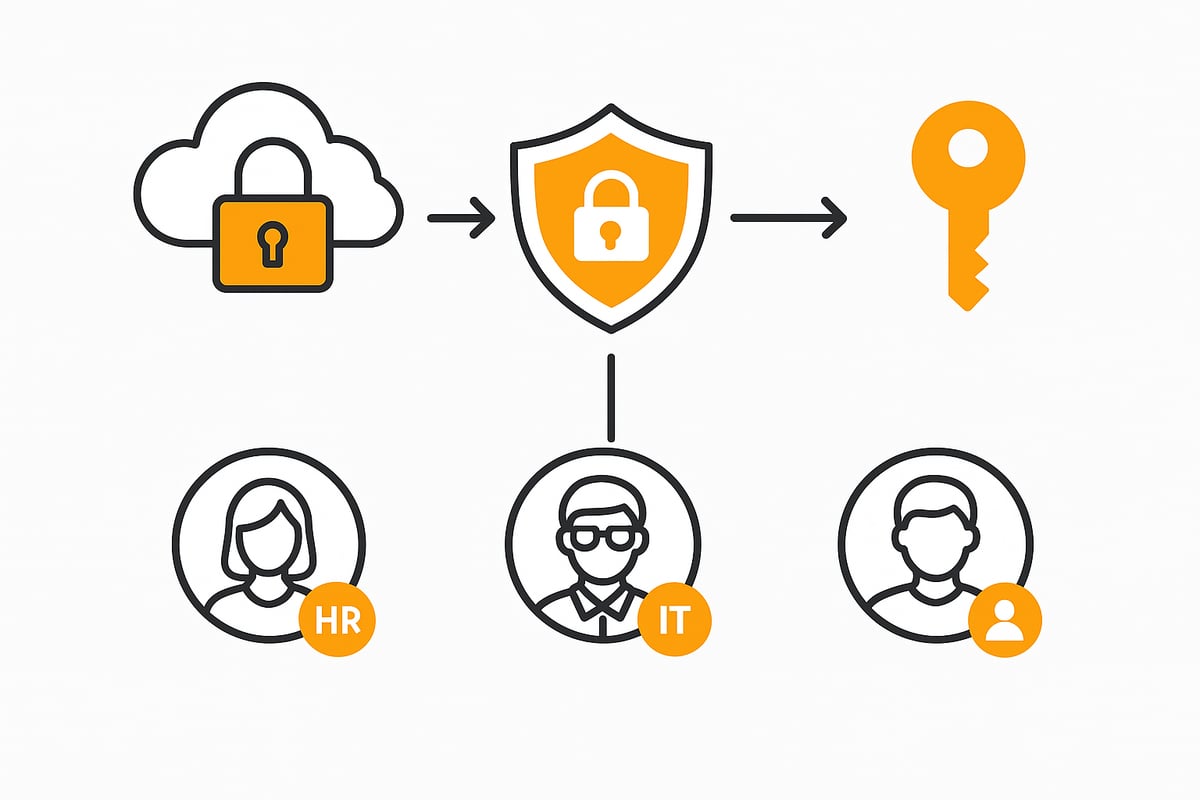
To make working time recording GDPR-compliant, technical and organizational measures are essential. This includes strict access control: only authorized users may view or edit data. Modern systems offer role-based permissions, so HR staff have different access than team leaders.
Further measures include:
-
Transmission control: protection against unauthorized transfer.
-
Input control: traceability of who makes changes.
-
Availability control: regular backups to prevent data loss.
Many companies rely on encrypted cloud solutions to securely manage working time recording. According to current figures, over 90 percent of companies with digital time recording already use role-based access management. This minimizes the risk of data breaches and creates a high level of legal certainty.
Transparency and acceptance among employees
Transparency is crucial for time recording to be accepted by everyone. Open communication about the purpose and scope of time recording alleviates employees’ concerns about monitoring. Information sessions, FAQ documents and regular updates help dispel uncertainties.
The works council should also be involved at an early stage to address concerns and jointly develop data protection concepts. Clear guidelines and the opportunity to ask questions build trust within the team. Companies that prioritize transparency benefit from higher motivation and smoother implementation of new systems.
Step-by-step guide: Introducing efficient and legally compliant working time recording
Implementing modern and legally compliant time recording requires a systematic approach. With this step-by-step guide, you’ll ensure your company meets all requirements while establishing efficient processes.
1. Analysis of the current state and needs assessment
At the beginning of every successful working time recording project is a thorough analysis. Check which working time models and recording methods are currently used. Are digital solutions already in place or is much still done manually?
Identify weaknesses such as lack of transparency, unclear break rules or error-prone processes. Involve HR, IT and the works council early on to gather perspectives. Example: In a 50-person company, the analysis showed that handwritten timesheets were often incomplete and required rework.
Create an overview of your company’s requirements. This lays the foundation for effective working time recording.
2. Selecting the right time recording system
Now it’s time to choose the right system for working time recording. Consider whether a digital or analog solution better suits your processes. Check criteria such as usability, scalability, cost structure and data protection.
Compare different providers, such as cloud solutions or on-premises software. Pilot projects help test acceptance within the team. Especially when selecting digital systems, it’s worth taking a look at Digital time recording obligation 2025 for current legal requirements and practical tips.
Example: A medium-sized company opted for an app-based solution after a trial that also covers mobile work.
3. Implementation and training
Implementation of working time recording starts with a clear schedule. Define when the new system will be introduced and who is responsible for the transition.
Provide comprehensive training for all employees and managers. Create practical guidelines and FAQs so everyone knows how recording works. Use onboarding workshops to reduce uncertainties.
Open communication promotes acceptance. For example, a company organized information events to answer questions directly and emphasize the benefits of the new time recording.
4. Ensuring data protection and compliance
Data protection is a central aspect of working time recording. Develop a GDPR-compliant concept that defines who has access to the data and how changes are documented.
Define clear roles and rights. Role-based permission management ensures that only authorized persons can view sensitive working time data. Regular reviews and updates of data protection measures are mandatory.
Example: Many companies rely on encrypted cloud systems to make time recording secure and traceable.
5. Continuous optimization and control
Working time recording is not a static process. Regularly analyze the recorded data to identify potential for optimization. Adapt the system when legal changes or new requirements arise.
Actively gather feedback from employees and the works council. An annual review of time recording processes helps address weaknesses early and ensure legal compliance.
This ensures that your working time recording remains efficient, transparent and legally compliant in the long term.
FAQ: The most important questions about working time recording 2025
From 2025, working time recording will be mandatory for all companies in Germany. What does that mean in everyday life? Here you’ll find answers to the most common questions about working time recording, new obligations and practical implementation.
What is changing with the time recording obligation from 2025?
From 2025, all employers must systematically document the start, end and duration of daily working hours. This obligation applies regardless of company size. You can find more about the legal background in this analysis of working time law innovations 2025.
From when does the obligation also apply to small businesses?
There is no transition period. The obligation to record working time applies immediately to all companies from 2025, including small businesses and start-ups.
Which systems are legally recognized?
Both analog and digital systems are permitted, as long as they are tamper-proof, complete and traceable at any time. Digital solutions are recommended because they offer greater legal certainty.
How long must working time data be retained?
The retention period is at least two years. In certain sectors, longer periods may apply, for example under the Minimum Wage Act.
What are the advantages of digital time recording?
Digital time recording saves time, reduces errors and simplifies evaluation. It also often integrates directly into payroll and offers better data protection.
What risks exist in the event of violations?
Anyone who does not implement working time recording correctly risks fines, back payments and legal disputes. Payroll can also become inaccurate.
How are overtime and breaks documented in a legally compliant manner?
Overtime and breaks must be recorded in the same way as daily working hours and stored in a traceable manner. Digital tools provide automatic reminders and evaluations here.
What role does the works council play in introducing new systems?
The works council has a right of co-determination when selecting and introducing systems for recording working hours. It ensures transparency, data protection and acceptance within the team.
You now have a clear overview of what to expect in 2025 in terms of working time recording—from new legal obligations to smart digital solutions. If you want to make your processes efficient, legally compliant and free of unnecessary effort, it’s worth relying on automation and data protection. filehub takes the tedious work off your hands: automate document workflows, comply with all legal requirements and increase your team’s productivity—no coding skills required. Try it out for yourself and start to try filehub.one for free now.


