How to Write a Reminder: Legal Basics & Practical Tips

When customers do not pay their invoices on time, writing dunning notices becomes part of everyday business. Yet many self-employed professionals and entrepreneurs are unsure: What are the legal requirements? When am I allowed to charge dunning fees? And how do I word a dunning notice so that it is effective without jeopardizing the customer relationship? In this comprehensive guide, you will learn everything important about dunning notices – from the legal basics and correct wording to automating the dunning process.
What is a dunning notice from a legal perspective?
A dunning notice is the formal request to a debtor to perform a due obligation – usually to settle an outstanding payment. It places the debtor in default and is therefore often a prerequisite for further legal steps.
The legal function of a dunning notice
Under German law, the dunning notice is of central importance. According to § 286 BGB, default occurs if the debtor fails to perform a due obligation and has been dunned. Only from this point on can default interest be charged and claims for damages asserted.
Important exceptions to the dunning requirement:
- If a calendar-specific payment date is set (e.g., "payable by 03/15/2026")
- For invoices to consumers with a payment term (30 days after due date)
- If the debtor seriously and definitively refuses payment
In practice, it is nevertheless advisable to send a dunning notice in order to document the occurrence of default beyond doubt. The Munich Chamber of Industry and Commerce provides a sample dunning letter that serves as a practical guide.
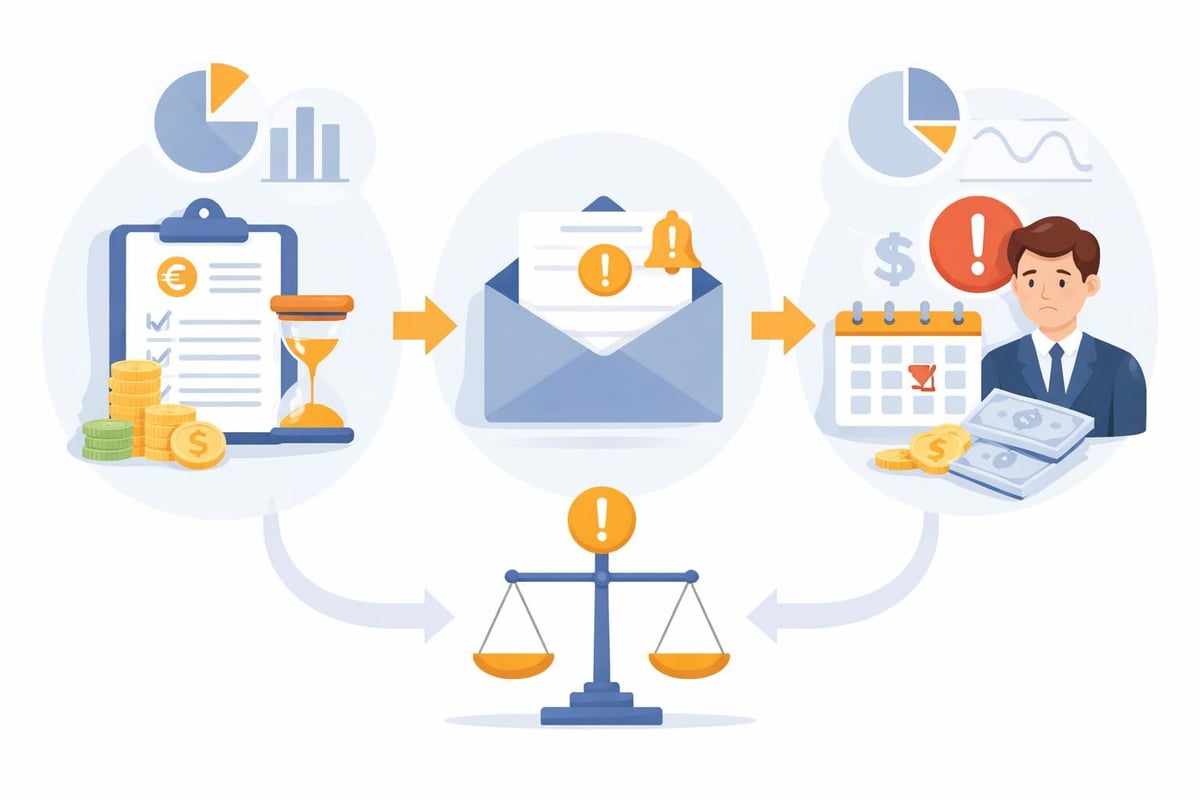
Mandatory components when writing a dunning notice
For a dunning notice to be legally effective, it must meet certain minimum requirements. A professional dunning letter, however, also contains additional elements that increase its effectiveness.
Formal requirements
| Mandatory information | Purpose | Example |
|---|---|---|
| Sender details | Identification of the creditor | Full company address |
| Recipient details | Assignment of the debtor | Name and address |
| Invoice number | Specification of the claim | RE-2026-0234 |
| Invoice amount | Amount of the claim | €1,450.00 gross |
| Due date | Proof of default | 02/28/2026 |
| Payment deadline | New deadline | 7 days from receipt of the dunning notice |
The dunning notice does not have to follow any specific form – it can be delivered in writing, by email, or even orally. For evidentiary reasons, however, the written form is always recommended. As Sage explains, the dunning notice should be clearly recognizable as such, even if the word "Mahnung" (dunning notice) does not necessarily need to be included.
Recommended additional details
- Date of the dunning notice for temporal classification
- Dunning fees, if permitted
- Default interest from the start of default
- Payment details (IBAN, payment reference)
- Consequences of further non-payment
- Contact person for queries
A friendly yet firm tone is crucial. The first dunning notice should allow for the possibility of an oversight, while later reminders may become increasingly formal.
The escalation levels: How often should you send reminders?
Most companies use a three-stage dunning system. This has proven itself in practice but is not required by law.
The three-stage dunning process
First dunning notice (payment reminder): The first notice is often still a friendly payment reminder. It assumes the payment may have been forgotten. Dunning fees are usually not charged at this stage.
Second dunning notice: After 7–14 days without a response, the second notice follows with a firmer tone. Dunning fees and default interest can now be asserted. The deadline should be clearly formulated.
Third dunning notice (final notice): The final notice announces specific legal steps: court order for payment, debt collection, or lawsuit. It contains one final, short deadline for payment.
Legally, you are not obliged to send multiple reminders. A single dunning notice is sufficient to trigger default. The multi-stage process primarily serves the customer relationship and out-of-court dispute resolution.

Time intervals between dunning notices
- From due date to 1st notice: 5–10 days
- Between 1st and 2nd notice: 7–14 days
- Between 2nd and 3rd notice: 7–10 days
- After 3rd notice until legal action: 5–7 days
These deadlines are guidelines and can be adjusted depending on the industry, order value, and customer relationship. For long-standing business partners, longer deadlines may be appropriate, while for new customers with large amounts, shorter intervals make sense.
Dunning costs and default interest: What may be charged?
A common point of contention when writing dunning notices is the costs. Which fees may be charged and from when?
Dunning fees from a legal perspective
Charging dunning fees is generally permissible if they cover the costs incurred. However, the amount must be reasonable.
Typical dunning fees in practice:
| Dunning stage | Typical amount | Legal basis |
|---|---|---|
| 1st notice | €0 – €5 | Goodwill, no fee |
| 2nd notice | €5 – €10 | § 288 BGB (loss caused by default) |
| 3rd notice | €10 – €15 | § 288 BGB (loss caused by default) |
These amounts typically cover postage, paper, labor time, and administrative effort. Excessive dunning fees can be challenged by the debtor. CHIP provides practical tips on fee levels, with flat rates of €5 for the first and €10 for subsequent notices considered standard in the market.
Calculating default interest
In addition to dunning fees, default interest can be charged from the time default begins. The amount is regulated by law:
- In transactions with consumers: Base rate + 5 percentage points
- In transactions between businesses (B2B): Base rate + 9 percentage points
The base rate is set semiannually by the Deutsche Bundesbank. As of 01/01/2026, it is -0.88%, resulting in default interest of 4.12% (B2C) and 8.12% (B2B).
Calculation formula: Default interest = (Claim amount × Interest rate × Days in default) / (365 × 100)
For an invoice of €2,000 with 30 days in default in the B2B sector, the result is: (2,000 × 8.12 × 30) / 36,500 = €13.35
Other reimbursable costs
In addition to dunning fees and default interest, the following may also apply:
- Costs for registered mail or proof of delivery
- Reasonable debt collection costs (if engaged)
- Attorney’s fees (from the court dunning procedure onward)
Wording and tone across the different dunning stages
Finding the right balance between firmness and professionalism is crucial when writing dunning notices. Each stage requires tailored communication.
First notice: Friendly reminder
The first notice should proceed on the assumption that the payment was inadvertently overlooked:
"Dear ..., it is possible that our invoice dated ... for ... € escaped your attention. We would like to kindly remind you to transfer the amount to our account by .... If payment has already been made, please disregard this letter."
This wording preserves the customer relationship and gives the debtor the opportunity to respond without losing face.
Second notice: Firm request
The second notice is more specific and mentions consequences:
"Dear ..., unfortunately, despite our payment reminder dated ..., we have not yet been able to record any payment. We request that you settle the outstanding amount of ... € plus dunning fees of ... € by .... Otherwise, we will be forced to take further steps."
Third notice: Final warning
The final notice announces specific legal steps:
"Dear ..., despite two reminders, the claim of ... € remains outstanding. This is our final out-of-court payment request. If the total amount of ... € (including default interest and dunning costs) is not received by ... , we will initiate the court dunning procedure without further notice."
SumUp offers comprehensive templates and examples that can be adapted for various industries.

Automating dunning for efficiency
Especially with many customers, manually writing dunning notices quickly becomes a time-consuming task. Modern automation solutions can provide significant relief here.
Benefits of automation
Time savings: Automated dunning runs drastically reduce manual effort. Once set up, workflows automatically check incoming payments and send dunning notices according to defined rules.
Consistency: Automated processes ensure that no dunning notice is forgotten and all deadlines are met. The risk of human error is significantly reduced.
Traceability: All dunning activities are documented, which is beneficial in later legal disputes.
Integration into existing systems
Modern platforms like filehub enable the seamless connection of accounting software, ERP systems, and document management. Through automated workflows, dunning processes can be fully digitized:
- Automatic reconciliation of open items
- Creation of personalized dunning letters
- Dispatch via email or postal mail
- Documentation in the customer database
- Escalation based on defined criteria
Particularly helpful is the ability to automatically retrieve invoices from web portals and integrate them into the dunning process. This creates an end-to-end, automated workflow from invoice receipt to payment reconciliation.
Special situations when writing dunning notices
Not every dunning situation is standardized. Certain constellations require special attention.
Dunning notices to regular customers
With long-standing business relationships, special caution is advisable. A personal conversation is often more effective than a formal dunning letter. First check:
- Are there known payment difficulties?
- Is there possibly an error in the invoice?
- Was the invoice sent to the correct department?
A brief call can resolve misunderstandings and preserve the relationship.
Cross-border dunning notices
In international business, additional particularities apply:
- Dunning notices should be written in the local language
- Observe the legal requirements of the destination country
- Factor in longer payment terms
- Consider currency fluctuations
Partial payments and installment plans
If customers signal payment difficulties, an installment agreement may be more sensible than escalation. Important points:
- Written documentation of the installments
- Default interest also for partial amounts
- Termination clause if an installment is not paid
- Documentation of the agreement
Digital delivery and burden of proof
The method of delivering a dunning notice is legally relevant, especially if court proceedings follow later.
Delivery methods compared
| Delivery method | Evidentiary value | Costs | Time |
|---|---|---|---|
| Regular mail | Low | Minimal | 1–3 days |
| Registered mail | Medium | Approx. €3 | 2–4 days |
| Registered mail with return receipt | High | Approx. €6 | 2–5 days |
| Low | None | Immediate | |
| Email with read receipt | Medium | None | Immediate |
| Fax | Medium (with transmission report) | Minimal | Immediate |
For the first notice, a regular email or letter is usually sufficient. From the second notice onward, registered mail is recommended; at the latest, the third notice should be sent by registered mail with return receipt.
Designing legally secure email dunning notices
Email dunning notices are generally valid, but providing proof is more difficult. The following measures increase legal certainty:
- Request a read receipt (not legally binding, but indicative)
- Archive the delivery confirmation
- PDF attachment instead of plain text (prevents tampering)
- Digital signature for additional security
Weclapp explains in detail how to design legally compliant digital dunning processes.
Dunning notices and statute of limitations
An often-overlooked aspect of writing dunning notices is the statute of limitations on claims. Dunning notices have a direct impact on limitation periods.
Regular limitation period and suspension (tolling)
The regular limitation period for claims is three years and begins at the end of the year in which the claim arose. An invoice from March 2026 therefore becomes time-barred on 12/31/2029.
Suspension of the statute of limitations through:
- Service of a court order for payment (Mahnbescheid)
- Filing a lawsuit
- Acknowledgment of the claim by the debtor
- Settlement negotiations
A simple dunning notice does not suspend the statute of limitations! However, it can prompt the debtor to acknowledge the claim, which restarts the limitation period.
Practical consequences
Those who wish to enforce their claims should act in good time. If limitation is looming, preventive measures may be advisable:
- Initiate court dunning proceedings (suspends limitation for 6 months)
- File a lawsuit (suspends until a final decision)
- Obtain written acknowledgment from the debtor
Avoid common mistakes
When writing dunning notices, various mistakes can impair effectiveness or even cause legal disadvantages.
The most common sources of error
Unclear amount of the claim: If the dunning notice does not state exactly which amount is being claimed, it is ineffective. Always specify the exact amount including the invoice number.
Missing or incorrect deadlines: A dunning notice without a payment deadline is ineffective. The deadline should be reasonable (at least 5–7 days) but not excessively long.
Excessive dunning fees: Dunning costs of €50 for a simple notice are not reasonable and can be challenged. Realistic flat rates between €5–€15 are common.
Aggressive or insulting tone: Threats or insulting wording can lead to ineffectiveness and even legal consequences.
Poor documentation: If it cannot be proven that and when a dunning notice was sent, it is worthless in legal disputes.
Checklist for effective dunning notices
- Complete sender and recipient data
- Clear invoice reference
- Exact amount of the claim
- Reasonable payment deadline
- Bank account details with IBAN
- Dunning fees and default interest (if applicable)
- Polite but firm tone
- Consequences of further non-payment
- Verifiable delivery
- Documentation in the system
Industry-specific considerations
Depending on the industry, different particularities may need to be considered when writing dunning notices.
Service providers and freelancers
Self-employed professionals and freelancers often face special challenges:
- Smaller order values make complex dunning procedures uneconomical
- Dependence on individual major clients makes consistent dunning harder
- Personal relationships take precedence
Taxfix provides valuable guidance specifically for the self-employed, including tax aspects.
Trades and construction
In the construction industry, the following particularities must be considered:
- Progress payments vs. final invoices
- Retention amounts
- Project acceptance as a prerequisite
- Contract for work and services law under the BGB
E-commerce and online retail
Online retailers particularly benefit from automation:
- High number of transactions
- Standardized processes possible
- Integration with shop systems
- Automatic payment reconciliation
Through connections to various platforms, dunning processes can be fully automated, from order confirmation to the final dunning notice.
Alternatives to the classic dunning process
The traditional dunning process is not always the best way to achieve the goal. There are various alternatives that may make sense depending on the situation.
Factoring and sale of receivables
With factoring, outstanding receivables are sold to a factoring company. Advantages:
- Immediate liquidity (80–90% of the receivable value)
- No need for your own dunning process
- Professional receivables management
Disadvantages include higher costs (factoring fees) and potential image issues with customers.
Debt collection service providers
From the third dunning notice onward, engaging a collection agency can be sensible:
- Psychological impact on the debtor
- Professional negotiation
- Legal expertise
In the case of justified claims, costs are borne by the debtor, although success-based commissions apply.
Court dunning procedure
The court dunning procedure is a cost-effective alternative to filing a lawsuit:
- Apply for a court order for payment (Mahnbescheid) (online via www.mahngerichte.de possible)
- Service by the court (official effect)
- If objection is filed: transition to litigation
- If no objection: enforcement order after 2 weeks
The costs depend on the amount in dispute and are set out in the Court Costs Act. For a claim of €500, the cost is about €35.
Integration with accounting software
The seamless connection between dunning and accounting is essential for efficient receivables management.
Benefits of system integration
An integrated solution offers numerous advantages:
- Automatic payment reconciliation avoids unnecessary dunning
- Real-time overview of open items
- Consistent data basis without manual transfers
- Automatic documentation of all dunning activities
Modern accounting solutions such as sevDesk, DATEV Unternehmen Online or Lexware can be connected via automation platforms.
Workflow automation
A typical automated dunning workflow could look like this:
- Accounting system checks open items daily
- Automatic check: Has the payment deadline expired?
- First dunning notice is generated and sent by email
- Documentation of the dunning notice in CRM and accounting
- Follow-up task for the second notice after 14 days
- Escalation to the responsible employee after the third notice
Through automated workflows, such processes can be implemented without any programming effort, which represents a tremendous efficiency gain especially for small and medium-sized enterprises.
Data protection and GDPR compliance
When writing dunning notices, personal data is processed, which is why the GDPR must be observed.
Relevant data protection aspects
Legal basis for processing: The processing of customer data for the purpose of dunning is based on Art. 6(1)(b) GDPR (contract performance) and (f) (legitimate interest).
Retention periods: Dunning notices and related documents must be retained for 10 years in accordance with commercial and tax regulations. After this period, there is an obligation to delete.
Disclosure to third parties: Engaging collection agencies or attorneys requires a data processing agreement (DPA) pursuant to Art. 28 GDPR.
Secure data processing
When automating dunning, special attention must be paid to data security:
- Encrypted transmission of all dunning letters
- Access controls for dunning data
- Logging of all accesses
- Regular backups
GDPR-compliant solutions like filehub, which are developed and operated in Germany, offer particular security thanks to server locations in Germany and strict data protection standards.
Writing dunning notices is an indispensable part of professional receivables management that requires both legal knowledge and diplomatic skill. With the right processes, clear wording, and appropriate deadlines, you can secure your liquidity without jeopardizing customer relationships. Automating recurring dunning processes saves valuable time and ensures consistency. filehub helps you automate your entire document management, including dunning – from automatic invoice capture and personalized dunning runs to seamless integration with your accounting software, fully GDPR-compliant and without any programming effort.


