Applying for a Tax Number - Step by Step

How can you apply for a tax number quickly and correctly in 2025? This question concerns many people who want to become self-employed or start a company. Without a tax number, the start stalls, because invoices cannot be issued correctly and tax returns cannot be filed.
Especially for the self-employed, freelancers, and founders, timely application is crucial to avoid delays and possible sanctions. In this guide, I’ll show you step by step how you can apply for a tax number, which documents you need, which deadlines apply, and which mistakes you’re better off avoiding.
You’ll also learn the difference between tax number, tax ID, and VAT ID, what requirements must be met, and how the online application works. Practical tips, frequently asked questions, and examples ensure that your application runs smoothly in 2025.
What is a tax number and why is it so important in 2025?
The tax number is the heart of your tax identification if you want to work self-employed in Germany. As soon as you want to apply for a tax number, the tax office assigns an individual number that uniquely identifies you and your business. Without this number, you cannot submit a correct tax return and cannot issue proper invoices with VAT shown.
Self-employed people, freelancers, and founders need the tax number for all important tax processes. It is not only relevant for income tax, but also for VAT, trade tax, and every invoice you issue. Anyone who wants to apply for a tax number should know: Only with the number are you officially operating as a taxable person.

Definition and function of the tax number
The tax number is a personal number assigned by your tax office that identifies you in all tax processes. It consists of 12 to 13 digits and is mandatory as soon as you act as a self-employed person, freelancer, or entrepreneur and want to apply for a tax number.
With the tax number, you report your income and expenses to the tax office. It is required on every invoice if you show VAT. Without a tax number, there is no legally valid invoicing and no tax recognition of your activity. So everyone who wants to apply for a tax number begins their self-employment with this step.
Difference: tax number vs. tax ID vs. VAT ID
In everyday tax life, you’ll encounter several numbers. The tax number is for businesses and the self-employed; it can change if you move or change your tax office. The tax ID, on the other hand, is a lifelong personal number for private tax matters. You need the VAT ID for business within the EU.
Here is an overview:
| Number | Purpose | Validity |
|---|---|---|
| Tax number | Businesses, invoices | Variable |
| Tax ID | Private, lifelong | Permanent |
| VAT ID | EU trade, value-added tax | Variable |
You can find more details in the article on the difference between tax number and tax ID. For everyone who wants to apply for a tax number, this distinction is essential.
Relevance in 2025
The year 2025 brings new challenges and opportunities for everyone who wants to apply for a tax number. Digitalization is progressing, and electronic tax filing via ELSTER is mandatory. This means faster processing, but also new requirements for your documents and data.
The processing time for a tax number is usually 1 to 4 weeks when done digitally. Legal changes and deadlines primarily affect founders and the self-employed, who must apply for a tax number in good time. If you make mistakes here or miss deadlines, you risk delays in invoicing and tax obligations.
Requirements & preparation: Who has to apply for a tax number?
Anyone starting a self-employed activity faces the question: Who actually has to apply for a tax number? The answer depends on the legal form, the activity, and legal requirements. Below you’ll find out which groups are affected, which deadlines must be met, and which documents you should have ready.

Target groups and obligations
The obligation to apply for a tax number affects various groups. These include founders, the self-employed, freelancers, tradespeople, and corporations such as GmbH or UG. Anyone starting a new activity is legally required to submit the application to the tax office.
For tradespeople, the following applies: First comes the business registration, then the application for the tax number. Freelancers such as doctors, journalists, or consultants do not need a business registration and can start directly. A comprehensive overview of the obligations is provided in the information sheet on tax registration for new founders.
Typical professions:
- Freelancers: designers, copywriters, doctors
- Tradespeople: online shop owners, craftspeople, retailers
- Companies: GmbH, UG, GbR
Deadlines and legal requirements
When applying for a tax number, timing is key. The application must be received by the relevant tax office no later than four weeks after starting the activity. If you miss the deadline, it can lead to delays in tax registration and VAT pre-registration.
The rule is especially important for small business owners: In the questionnaire for tax registration, you can choose the small business regulation, provided your turnover does not exceed 22,000 euros in the first year and 50,000 euros in the following year. Stick to the deadlines to avoid legal issues and financial disadvantages.
Required documents and data
To apply for a tax number, several documents and details are required. Have these ready to speed up the process:
- Valid ID card or passport
- Business registration, if applicable
- Tax identification number (tax ID)
- Information about the activity and planned revenues/profits
- Bank account details for tax refunds or debits
The more complete your documents are, the smoother the application will be. Carefully check all details so the tax office can process your application quickly.
Step-by-step guide: Apply for a tax number in 2025
Do you want to apply for a tax number in 2025 and don’t know where to start? Here you’ll find a clear step-by-step guide that will safely take you through the entire process. Each step is important so that you fulfill your tax obligations correctly and can start your self-employment right away.
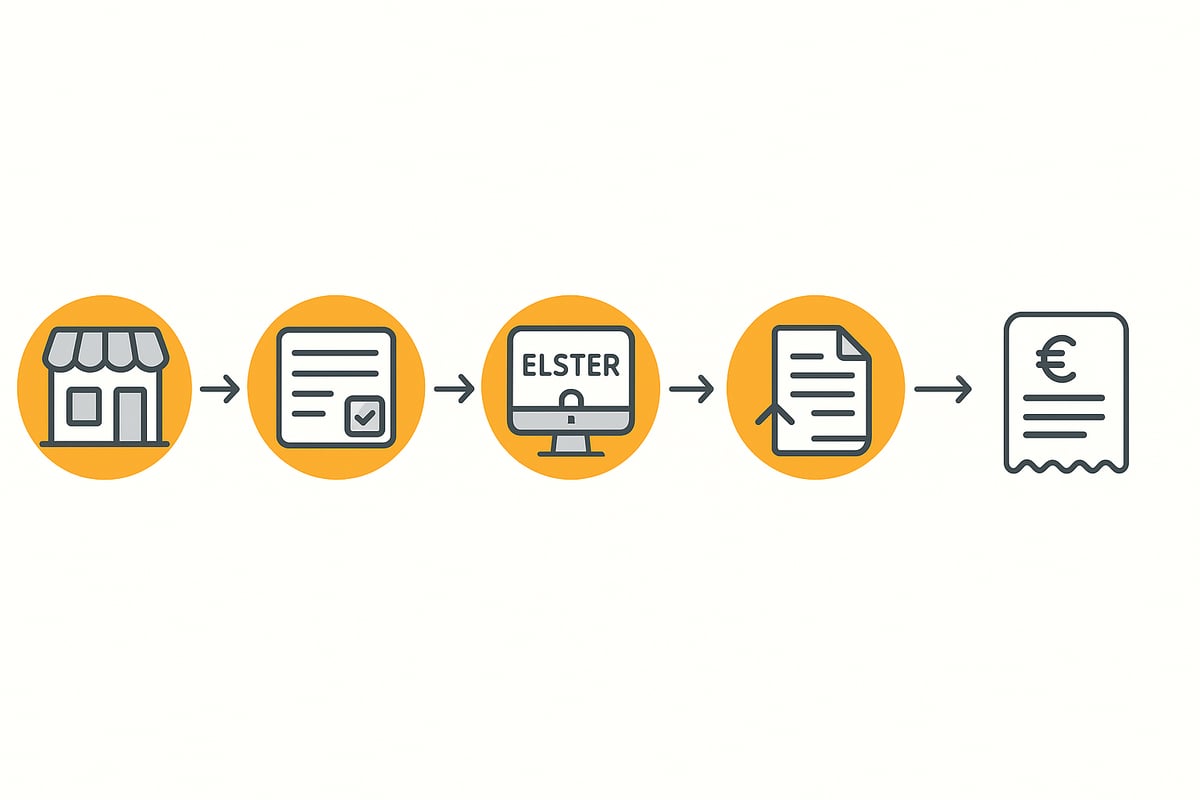
Step 1: Determine the type of self-employment
Before you can apply for a tax number, you need to know whether you’re starting as a freelancer or as a tradesperson. This is crucial for the process.
Tradespeople must first register their business at the trade office. After registration, you will automatically receive mail from the tax office with instructions for the next step.
If you’re a freelancer, the business registration is not required. You can directly fill out the questionnaire for tax registration. Typical freelancers are doctors, journalists, or consultants, while online shop owners or craftspeople usually have to register a business.
Tip: If you’re unsure, a call to the tax office will help clarify your classification. This way, you ensure that you’re on the right path from the start and can apply for a tax number.
Step 2: Fill out the questionnaire for tax registration
After you’ve categorized your self-employment, the next step is to fill out the questionnaire for tax registration. This is the basis for applying for a tax number.
You can get the form either via the ELSTER portal (elster.de) or in paper form directly from the tax office. Make sure you select the correct form, usually for sole proprietors or freelancers.
In the questionnaire, you enter the following data:
- Personal details and contact information
- Description of your activity
- Expected revenues and profits
- Bank account details for tax payments or refunds
- Option to apply the small business regulation
Estimate your revenues realistically, because overly high figures lead to high prepayments, and figures that are too low lead to back payments. The questionnaire must be submitted no later than four weeks after starting the activity so that you can obtain your tax number in good time.
Step 3: Online application with ELSTER
The easiest and fastest way to apply for a tax number is to submit the application online via ELSTER. To do this, register on elster.de and choose a login method, such as a certificate file, ElsterSecure, or your ID card.
The advantages of applying digitally:
- Automatic plausibility check of your entries
- Faster processing by the tax office
- No paperwork, everything accessible online
For the initial application, a complete registration with a certificate file is not always necessary. Many tax offices also accept simplified access for the first contact. Especially in 2025, digital applications are given priority, which speeds up the process.
If you need help, there are guides on ELSTER, or you can contact the tax office by phone. This way, you can apply for a tax number with ease.
Step 4: Submit documents & processing time
Now it’s time to send all documents to the tax office. This includes the completed questionnaire and, if applicable, other documents such as the business registration or copies of your ID. You can upload everything digitally or send it by post.
Many founders digitize their documents in advance to speed up the process. You’ll find practical tips on digital organization of your documents in this post: Tips for digital document management.
The processing time is usually between one and four weeks, depending on the workload of the tax office. In urgent cases, you can apply for a provisional tax number. Once the review is complete, you’ll receive the tax number by post.
Check your mailbox regularly so you don’t miss the next step and can start working immediately with your tax number.
Step 5: Receive and use the tax number
After processing, you’ll receive your tax number by post. You can now officially issue invoices, show VAT, and submit all tax filings correctly.
It’s important to keep the tax number safe. It’s needed for all tax-related processes, whether for the tax return, VAT pre-registration, or when the tax office makes inquiries.
Always include the tax number on your invoices, especially if you are liable for VAT. This way, you fulfill all legal requirements and can run your business without delays. Those who apply for a tax number in good time avoid unnecessary waiting and problems.
Typical mistakes and how to avoid them
There are a few pitfalls when applying for a tax number. The most common mistakes are incomplete or incorrect information in the questionnaire, such as a missing bank account or an unrealistic revenue forecast.
Missing the deadline for submitting the form can also lead to delays. Many people also confuse tax number, tax ID, and VAT ID. This later causes problems when issuing invoices.
Here’s how to avoid these mistakes:
- Carefully check all information in the questionnaire
- Have all documents ready and digitize them early
- Contact the tax office if you’re unsure
- Note all deadlines and check your mailbox regularly
With these tips, you can apply for a tax number without unnecessary mistakes and delays. This way, you can start your self-employment safely and without stress.
Apply for a tax number online: advantages, specifics & tips
Digitalization makes it easier than ever to apply for a tax number. More and more founders and self-employed people are therefore opting for the online application. Here’s what to expect, what advantages the digital route offers, and what you should pay attention to.

Digital application via ELSTER
If you want to apply for a tax number, you can conveniently do it online via ELSTER. To do this, register using a certificate file, ElsterSecure, or your ID card. The entire process is self-explanatory and structured step by step.
The plausibility check in the system helps to detect errors in the application early on. This saves you not only time but also follow-up queries from the tax office. Digital applications are usually processed faster than paper forms.
Advantages of applying online
Applying for a tax number online offers numerous advantages:
- You can submit the application anytime and from anywhere.
- No waiting for appointments or postal delivery of forms.
- All documents and applications are clearly organized in the ELSTER portal.
- You can submit documents digitally later if needed.
For the self-employed and founders, online application is a real efficiency boost. Processing time is often significantly reduced, which is crucial when starting a business.
Specifics and potential challenges
Even when applying for a tax number online, there are a few details to keep in mind. You need a stable internet connection and possibly a card reader for your ID card. The tax number itself will still be sent to you by post, regardless of the digital application.
If you encounter technical problems, the ELSTER hotline or a tax advisor can help. After submitting, check your mailbox regularly so you can use the tax number right away.
Tips for a smooth process
To ensure everything goes smoothly when applying for a tax number, prepare well:
- Scan all required documents in advance.
- Fill out the questionnaire carefully and completely.
- Check your information for accuracy.
- Keep an eye on your mail after submitting.
After receiving your tax number, you can start invoicing right away and organize your bookkeeping digitally. How to master this next step efficiently is explained in the article Optimize accounting and tax processes.
Frequently asked questions & problems when applying for a tax number (FAQ)
Anyone applying for a tax number for the first time often encounters the same uncertainties. Here you’ll find concise answers to the most common questions so your application runs smoothly.
What is the difference between a tax number and a tax ID?
The tax number is for businesses and the self-employed, while the tax ID is assigned once to every private individual. Both numbers serve identification, but only people with self-employed income need to apply for a tax number.
How do I find my responsible tax office?
Use the postal code search on the website of the Federal Central Tax Office. There you’ll quickly find the right tax office for your place of residence or business.
Who has to apply for a tax number?
Everyone starting a self-employed activity or business must apply for a tax number. This includes founders, freelancers, sole proprietors, and corporations.
How long does processing take?
Processing time is usually 1 to 4 weeks. Digital applications via ELSTER are often processed faster than paper forms.
What should I do if there are errors in the application?
Errors can usually be resolved by briefly contacting the tax office. Correct information as soon as possible to avoid delays.
When do I need a VAT ID?
The value added tax identification number is required if you offer goods or services within the EU. A detailed explanation can be found in the value added tax identification number (VAT ID) explanation.
Which documents are mandatory?
You need a valid ID card or passport, possibly the business registration, your tax ID, and the completed questionnaire for tax registration.
Can I complete the application by phone?
The actual application is made via ELSTER or in paper form. However, you can get assistance with the individual steps by phone.
What happens if I miss the deadline?
Those who miss the deadline to apply for a tax number risk delays in tax registration. This can negatively affect VAT pre-registrations or invoicing.
A tip: As soon as you’ve applied for the tax number, it’s worth taking a look at accounting for the self-employed. This will prepare you optimally for the next steps and allow you to keep your bookkeeping correct from the start.
Practical examples & tips for a fast and secure application in 2025
Do you want to know how applying for a tax number works in practice? Here you’ll find concrete examples, tips, and a checklist to ensure your application goes smoothly in 2025.
Example 1: Founder of an online shop
Max is founding an online shop in 2025. After registering his business, he automatically receives mail from the tax office. The next step is to apply for a tax number by completing the questionnaire for tax registration online via ELSTER. After a few weeks, the tax number arrives by post. Only then may Max issue invoices showing VAT.
Example 2: Freelance graphic designer
Sophie is starting as a freelance graphic designer in 2025. She does not need to register a business. She directly completes the questionnaire for tax registration at the tax office. After successfully applying for a tax number, she can bill her first clients and include the tax number on her invoices.
Example 3: Choosing the small business regulation correctly
Paul wants to start as a small business owner. When applying for a tax number in the ELSTER questionnaire, he selects the “small business regulation” option. This exempts him from charging VAT as long as his turnover remains below 22,000 euros in the first year and 50,000 euros in the following year.
Checklist & tips for a fast application
Checklist for applying for a tax number in 2025:
| Step | Done? |
|---|---|
| ID card ready | |
| Fill out ELSTER questionnaire | |
| Business registration (if needed) | |
| Provide bank account details | |
| Estimate turnover realistically |
Tip: After applying for a tax number, you should set up your bookkeeping digitally right away. You can find out how in the guide Digitize bookkeeping easily.
Statistics & recommendation
It is estimated that 80% of applications are already submitted digitally. If you move or change tax offices, you’ll receive a new tax number. If you’re unsure, it’s always worth contacting the tax office or a tax advisor.
You now know the most important steps to apply for your tax number quickly and without errors in 2025—from proper preparation and the digital application to avoiding typical pitfalls. If you want your document processes to run just as smoothly and automatically as your application, then try filehub: With just a few clicks, you can efficiently design workflows around invoices, receipts, or letters and gain more time for your core business. Try filehub.one for free now and experience how simple automation can be: Try filehub.one for free now


