Amazon Seller Central Europe: Automation & Efficiency
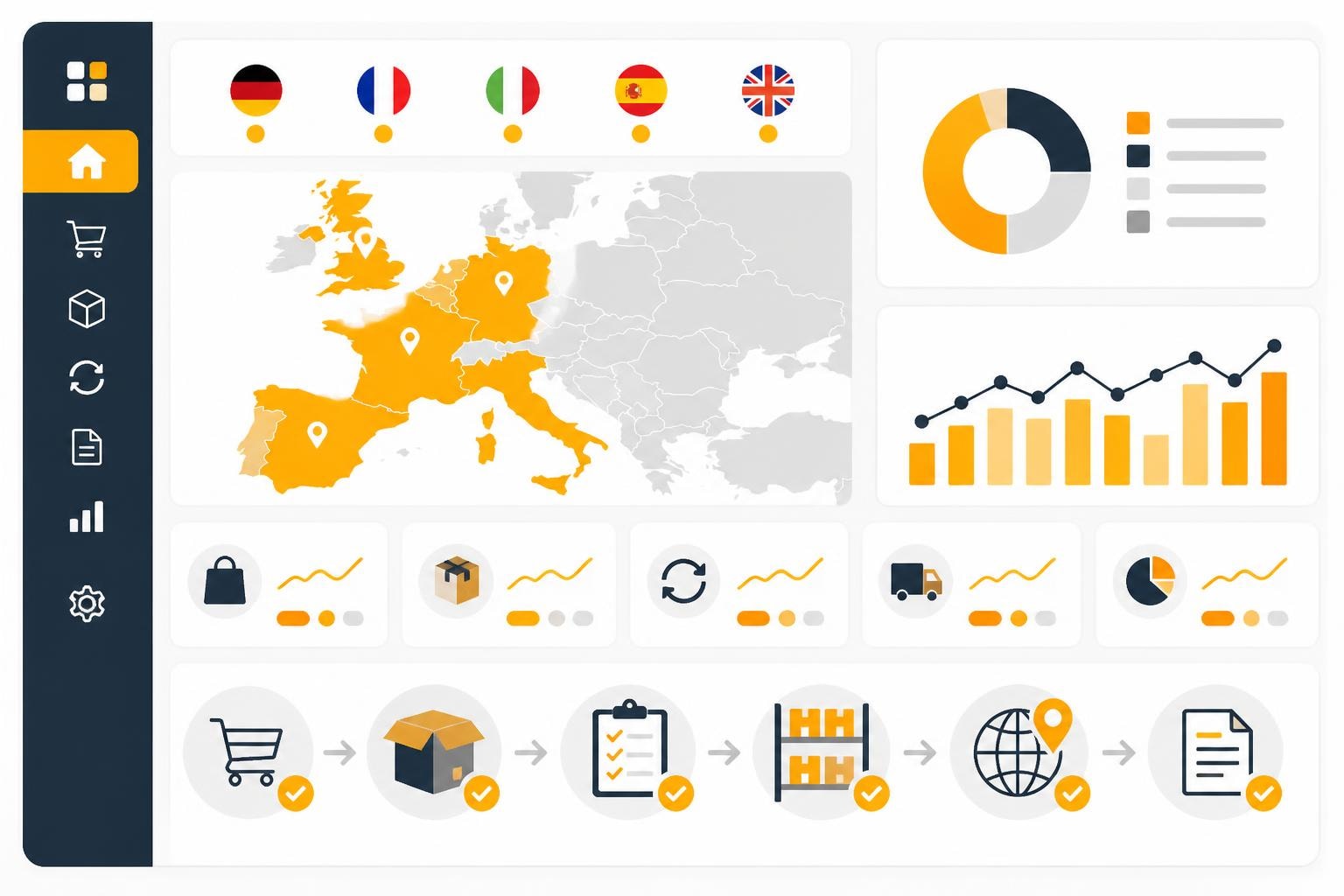
The European e-commerce market offers enormous opportunities for online retailers, and Amazon Seller Central Europe is the central platform that provides access to millions of customers in various countries. However, managing sales across multiple European markets involves specific challenges: different VAT rates, diverse compliance requirements, and an exponentially growing volume of documents. While many sellers focus on product optimization and marketing, they often underestimate the administrative effort associated with cross-border trade. In this article, we show you how to make optimal use of amazon seller central europe while significantly saving time and resources through automation.
Understanding the structure of Amazon Seller Central Europe
Amazon Seller Central Europe fundamentally differs from other regional Amazon platforms through its integrated multi-country management. The platform from Amazon allows you to sell in multiple European countries through a single account, including Germany, France, Italy, Spain, the Netherlands, Poland, and Sweden.
Central account structure
The European Seller Central provides a unified user interface through which you manage all your European marketplaces. This consolidation brings several benefits:
- Unified inventory management: Manage stock centrally for all markets
- Consolidated financial reports: Overview of revenues and fees from all countries
- Pan-European FBA: Use fulfillment services across borders
- Shared product listings: Create listings once and adapt them for different markets
A key aspect is handling different VAT rates. While you calculate at 19% in Germany (or 7% for certain products), Italy has 22%, France 20%, and Spain 21%. This complexity requires precise accounting processes.
Pan-European expansion with Export Central
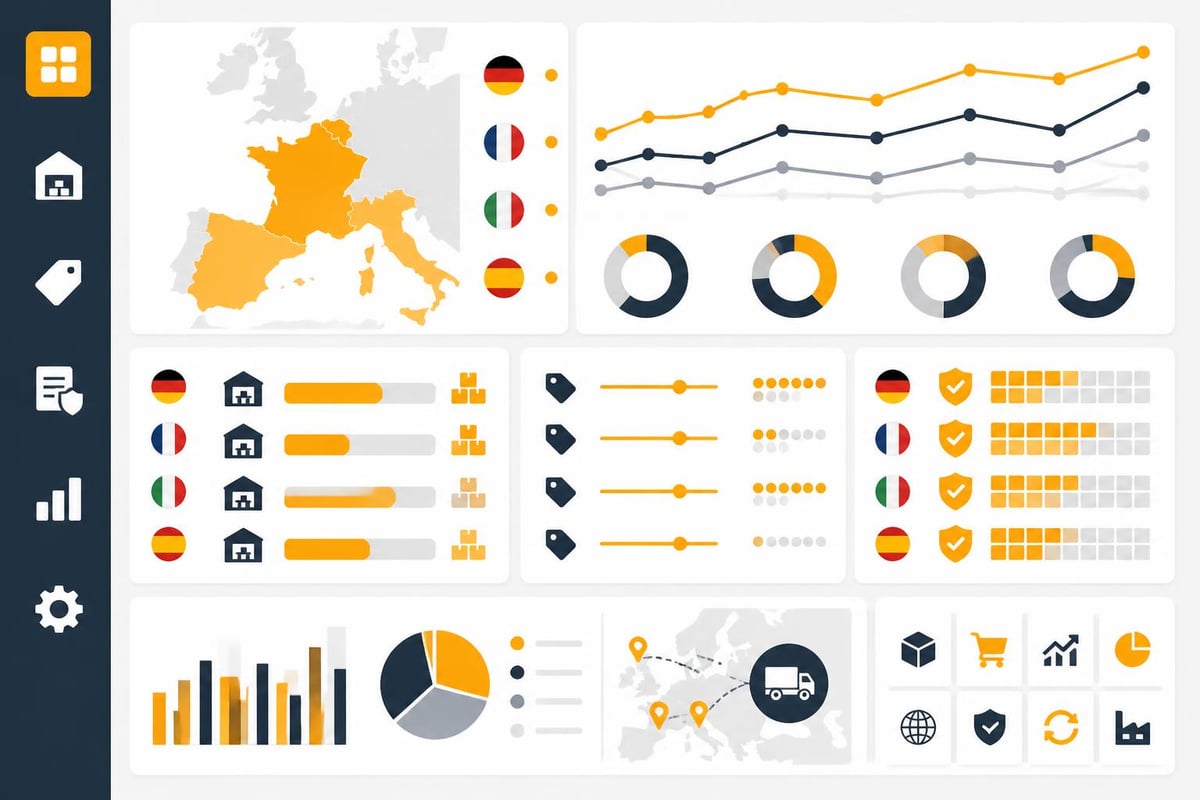
With Export Central, Amazon has simplified expansion, allowing sellers to sell to up to 39 European countries with just a few clicks. This feature significantly reduces technical hurdles but at the same time increases the volume of administrative documents.
Document management: The underestimated challenge
Every sale via amazon seller central europe generates various documents: invoices, delivery notes, tax reports, and compliance records. With hundreds or thousands of transactions per month, a massive administrative workload arises.
| Document type | Frequency | Manual processing time | Automation potential |
|---|---|---|---|
| Invoices | Per order | 2–5 minutes | High (95%) |
| VAT reports | Monthly | 2–4 hours | Very high (90%) |
| Inventory reports | Weekly | 30–60 minutes | High (85%) |
| Tax documents | Quarterly | 4–8 hours | Medium (70%) |
The challenge lies not only in retrieving these documents but also in their systematic storage, further processing, and integration into existing accounting systems. Similar to the automated invoice retrieval from Booking.com, Amazon documents can also be processed automatically.
Compliance and legal requirements
Strict regulations apply in Europe for electronic invoicing and document retention. The GDPR also requires special care when handling customer data. Amazon seller central europe does provide tools to support compliance, but you often still have to transfer the documents manually into your own systems.
Particularly critical are:
- Retention periods: In Germany, 10 years for tax-relevant documents
- Audit-proofing: Immutability of archived invoices
- Data protection: GDPR-compliant storage and processing
- Rapid availability: Documents must be provided immediately during audits
Automating Amazon Seller Central workflows
Automating document and data flows is no longer a luxury but a necessity for competitive Amazon sellers. Modern workflow automation can reduce administrative effort by up to 80%.
Automated invoice processing
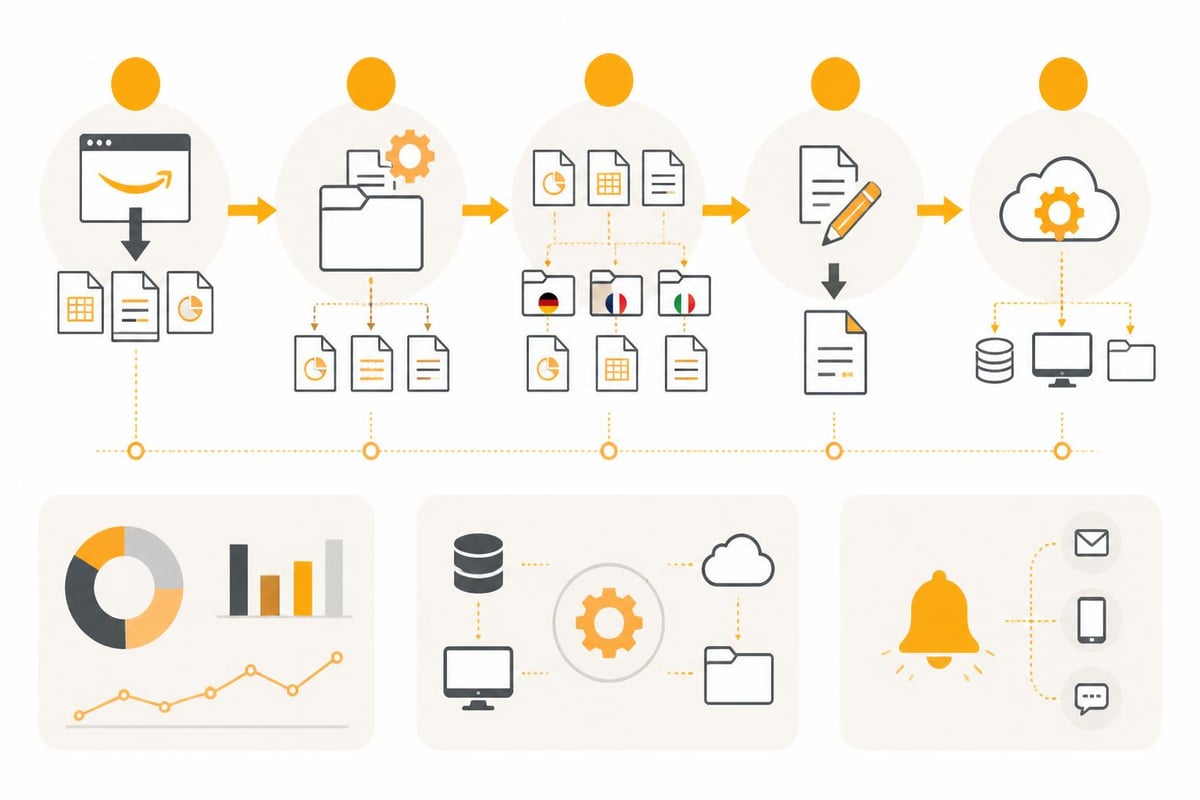
A typical challenge: In Seller Central, Amazon provides various reports and documents that you must regularly download, categorize, and forward to your accounting. With an automated file automation, this process can be fully optimized.
Typical manual workflow:
- Daily login to amazon seller central europe
- Navigate to the reports
- Download the relevant files
- Rename according to your internal schema
- Upload into the accounting software
- Manual matching and verification
Automated workflow:
- Automatic retrieval of all new documents from Seller Central
- Intelligent classification by document type and marketplace
- Automatic renaming according to your naming convention
- Direct transfer into accounting systems like Lexoffice or DATEV
- Automatic notification in case of discrepancies or missing documents
Integration with accounting systems
The seamless connection between amazon seller central europe and your financial software is crucial for efficient processes. Modern automation platforms can connect to various systems:
- DATEV Unternehmen Online for tax advisor collaboration
- SevDesk for small and medium-sized businesses
- Microsoft Dynamics 365 Business Central for larger organizations
- Lexware Office as an established accounting solution
These integrations enable bidirectional data flow: Sales data automatically flow into accounting, while inventory information is synchronized back to Amazon.
Optimizing operational processes
Beyond pure document management, there are other operational areas that can benefit greatly from automation.
Inventory management across multiple markets
When selling via amazon seller central europe in different countries, synchronizing stock levels is critical. Overselling leads to customer dissatisfaction and negative reviews, while overly conservative inventory management wastes revenue opportunities.
Challenges with pan-European inventory:
- Different sales velocities by market
- Variable lead times between countries
- Seasonal fluctuations per region
- Cross-border stock transfers
An automated solution continuously monitors stock levels, generates alerts at critical thresholds, and can even trigger reorders automatically. The Web Retrieval function enables you to regularly pull data from Seller Central and integrate it into your internal systems.
Order processing and shipping automation
Order processing across multiple European markets requires precise coordination. Automation can help in several areas:
- Order import: Automatic retrieval of new orders from all marketplaces
- Address validation: Check and standardize shipping addresses
- Shipping labels: Automatic generation according to country-specific requirements
- Tracking updates: Feedback to Amazon about shipping status
- Document archiving: Systematic storage of all shipping-related documents
The Order Management automation can link these processes seamlessly while accounting for different carriers, shipping classes, and customs regulations.
Strategies for effective multi-market selling
To succeed on amazon seller central europe, you need more than just technical systems. A well-thought-out strategy considers cultural differences, market specifics, and local preferences.
Localization vs. standardization
| Aspect | Standardization | Localization | Recommendation |
|---|---|---|---|
| Product images | Uniform | Culture-specific | Standardization |
| Product descriptions | Translation | Native texts | Localization |
| Pricing | Same across the euro area | Market-based | Localization |
| Customer service | Centralized | Local | Hybrid |
| Keywords | Translated | Researched | Localization |
The challenge is finding the right balance. While product images can often be standardized, product descriptions and keywords require careful localization. A German customer might search for "Küchenmaschine," while a French customer enters "robot de cuisine."
Pricing across European markets
Pricing on amazon seller central europe is complex. You must consider various factors:
- VAT rates: From 17% (Luxembourg) to 27% (Hungary)
- Competitive landscape: Varies greatly by market
- Purchasing power: Different income levels and price elasticities
- Shipping costs: Cross-border shipping vs. local storage
- Currency fluctuations: In non-euro countries such as Poland or Sweden
Automated pricing tools can continuously monitor these factors and adjust prices dynamically to optimize competitiveness and margin.
Data-driven decision-making
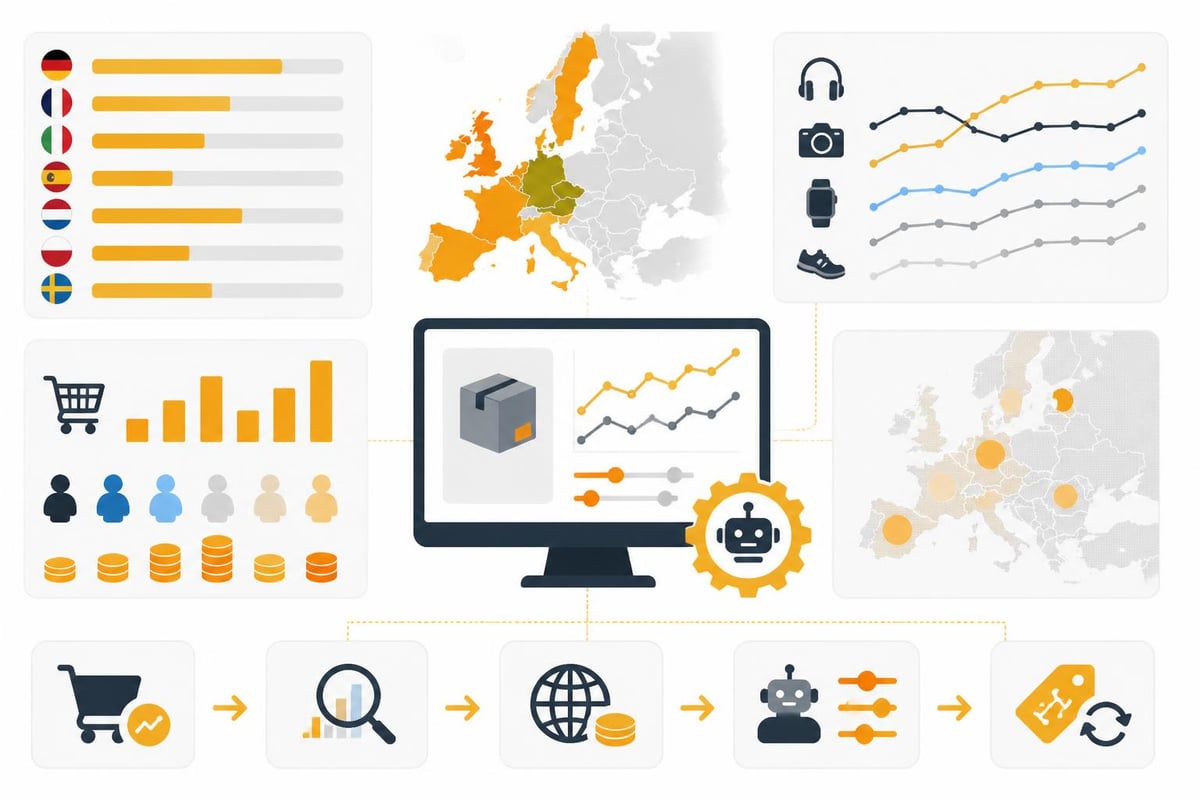
Amazon seller central europe generates massive amounts of data that offer valuable insights into your business. The challenge is to consolidate, analyze, and turn this data into actionable insights.
Key metrics and KPIs
Performance metrics per market:
- Conversion rate: How many visitors actually buy?
- Average order value (AOV): Average order value per country
- Return rate: Return rate by market
- Customer lifetime value: Long-term customer value
- Advertising cost of sales (ACoS): Advertising efficiency
A research paper on factors that influence sales rank shows that certain metrics are significantly stronger predictors of success than others. Especially relevant are review velocity, price-performance ratio, and product image quality.
Reporting and analytics automation
Manual reporting across different markets is time-consuming and error-prone. An automated solution can:
- Generate daily performance dashboards
- Automatically detect and report anomalies
- Visualize comparisons between markets
- Create predictive analyses for inventory planning
- Create custom reports according to your specific requirements
The collected data can be integrated into business intelligence tools such as Power BI or Tableau to gain deeper insights. The Finance solution from filehub enables you to consolidate financial data from various sources and create meaningful reports.
Technical integration and API usage
For advanced users, amazon seller central europe offers extensive API access that enables deep automation. The various Seller Central URLs for European markets are important for programmatic access.
Amazon MWS and SP-API
The Amazon Selling Partner API (SP-API) has replaced the older MWS API and offers expanded possibilities:
- Orders API: Retrieve and manage orders
- Catalog API: Manage product data and listings
- Fulfillment API: FBA integration and shipping management
- Finances API: Transaction and settlement data
- Reports API: Access to various reports
These APIs make it possible to develop custom integrations that are perfectly tailored to your specific business processes. However, direct API use requires technical know-how and development resources.
No-code automation as an alternative
Not every company has developer capacity for API integrations. No-code platforms offer an attractive alternative. They allow you to build complex workflows without programming while still using full functionality.
With a workflow automation without code, you can:
- Establish connections to amazon seller central europe with a click
- Design multi-step automations visually
- Define conditions and branches without programming
- Link different systems together
- Implement changes quickly and flexibly
These approaches democratize automation and make it accessible even to smaller sellers and teams without an IT department.
Security and data protection in automation
When automating processes around amazon seller central europe, data security is of utmost importance. You process sensitive business data, customer addresses, and financial information.
GDPR-compliant data processing
The General Data Protection Regulation imposes strict requirements on the processing of personal data:
- Data minimization: Collect and process only the data necessary
- Purpose limitation: Use data only for defined purposes
- Storage limitation: Do not retain data longer than necessary
- Integrity and confidentiality: Appropriate security measures
- Accountability: Proof of compliance
When choosing an automation platform, you should ensure that it is hosted in Europe and operates in compliance with the GDPR. The data security at filehub is ensured, for example, through German servers and strict compliance policies.
Access management and audit trails
Who accessed what data and when? This question is crucial during audits. A good automation system should:
- Enable granular access rights
- Maintain complete audit logs of all actions
- Use encryption for data at rest and in transit
- Conduct regular security audits
- Provide certifications such as ISO 27001
Scaling and growth in European markets
Amazon seller central europe offers enormous opportunities for scaling—but only if your systems and processes can grow with you. A study on platform dynamics shows that sellers who implement automation early achieve significantly higher growth rates.
From one market to pan-Europe
Many sellers start in their home market and then expand step by step. The typical progression:
- Phase 1: Single home market (e.g., Germany)
- Phase 2: Expansion into 2–3 core markets (+ France, Italy)
- Phase 3: Full EU-5 coverage (+ Spain, UK)
- Phase 4: Smaller markets and Northern Europe
- Phase 5: Pan-European optimization
Each phase brings new complexity. What was still manageable manually in Phase 1 becomes a bottleneck from Phase 3 onward without automation. An operations solution can be crucial here to ensure operational excellence across all markets.
Managing seasonality and peak loads
European markets have different seasonal patterns. While Germany peaks in December, January in Spain is shaped by "Reyes Magos," and France has its own regional particularities.
Critical periods:
- Black Friday / Cyber Monday: Pan-European
- Holiday season: Different timing by country
- Summer sales: July/August in Southern Europe
- Back-to-school: September, varying intensity
Automated systems can prepare you for these peaks by analyzing historical data, creating demand forecasts, and sending timely alerts. The backup routine function also ensures that no critical data is lost during high-load periods.
Best practices for Amazon Seller Central Europe
From the practice of successful European Amazon sellers, several recurring patterns of success can be derived:
Documentation and standardization
Create standard operating procedures (SOPs) for all recurring processes:
- Onboarding new products in different markets
- Handling customer returns by country
- Escalation processes for performance issues
- Regular quality checks of listings
- Monitoring and reporting cadences
These SOPs form the basis for successful automation. Only if you understand exactly how a process should run can you automate it effectively.
Continuous testing and optimization
Amazon seller central europe is constantly evolving. New features, changed algorithms, and market dynamics require continuous adaptation:
Testing framework:
- A/B tests for product titles and descriptions
- Pricing experiments per market
- Test different advertising strategies
- Conversion optimization through different image variants
- Continuously review keyword performance
The insights gained should be documented systematically and integrated into your automation workflows. A template library can help replicate proven processes quickly.
Cross-functional collaboration
Success on amazon seller central europe requires collaboration among different teams:
- Marketing: Product positioning, advertising, content
- Operations: Inventory management, shipping, quality
- Finance: Pricing, reporting, tax compliance
- Customer service: Support, returns, reviews
Automated workflows can connect these teams by delivering relevant information to the right people at the right time. Workflow automation makes it possible to orchestrate cross-team processes seamlessly.
Future trends and developments
European e-commerce is evolving rapidly. Several trends will shape the use of amazon seller central europe in the coming years:
Increasing regulatory compliance
The EU is continuously tightening regulations for online sellers:
- Digital Services Act (DSA): New transparency obligations
- Digital Markets Act (DMA): Regulation of large platforms
- Extended Producer Responsibility (EPR): Packaging responsibility
- VAT e-commerce package: Simplified VAT processing since 2021
These developments increase compliance requirements. Automated systems that take regulatory updates into account and warn you proactively will become increasingly important. Connecting to tax advisor systems such as DATEV will become standard.
AI and machine learning
Artificial intelligence is revolutionizing selling on amazon seller central europe:
- Predictive analytics: Forecasting demand trends
- Dynamic pricing: AI-driven price optimization
- Content generation: Automatic creation of localized product descriptions
- Fraud detection: Identifying unusual patterns and fraud attempts
- Customer sentiment analysis: Evaluation of reviews and feedback
These technologies are increasingly becoming accessible to smaller sellers as well, often embedded in automation platforms and tools.
Sustainability and transparency
European consumers are placing increasing value on sustainability. Amazon is responding with initiatives such as "Climate Pledge Friendly" and transparency requirements:
- Origin information and supply chain transparency
- Carbon footprint of products and shipping
- Packaging optimization and recycling
- Local sourcing and shorter delivery routes
A study on incentives on e-commerce platforms shows that sustainability is increasingly becoming a competitive factor. Sellers who can meet and communicate these requirements achieve better conversion rates.
Successfully using amazon seller central europe requires more than just good products—it demands efficient processes, intelligent automation, and strategic thinking across different markets. The administrative effort increases exponentially with each additional market, and manual processes quickly become a brake on growth. This is exactly where filehub comes in: The platform lets you automatically retrieve documents from web portals such as Amazon Seller Central, process them according to your specifications, and integrate them seamlessly into your existing systems—GDPR-compliant, secure, and without programming.


